
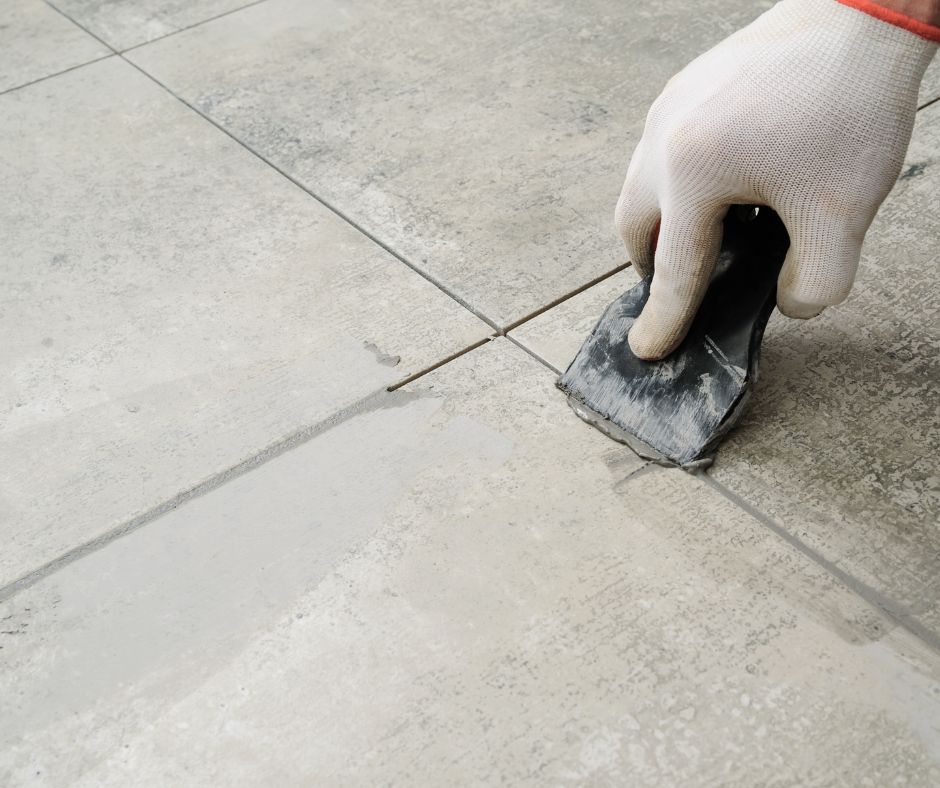
I’ve been on the tools fixing showers in Sydney since 2016, and here’s the question I get asked at least once a week, “can we just regrout it instead of doing the whole bathroom?” Most of the time, yes. Sometimes, no. The answer depends on what’s actually wrong with the bathroom, not what you want it to look like at the end.
This isn’t an article about why regrouting is “always better than renovating”. It’s not. It’s about when each one makes sense, what each one costs, and what you’ll actually get for the money.
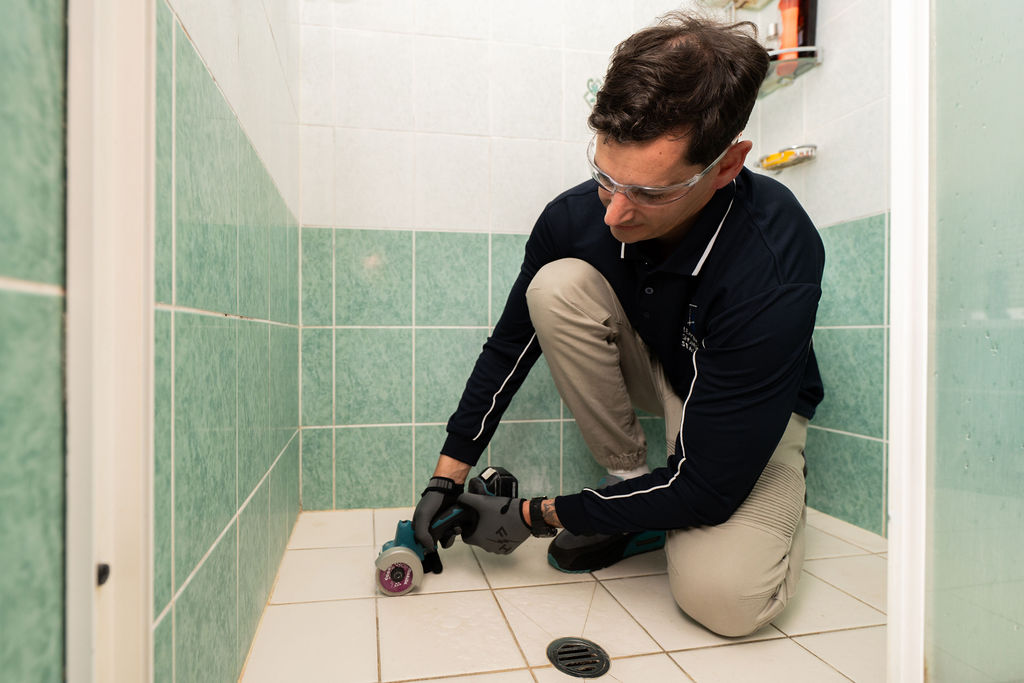
The short answer
Yes, regrouting is a legitimate budget alternative to a renovation, but only if your tiles are still in good condition. A professional shower regrout in Sydney runs from $1,400 inc GST for the walls and floor, with most jobs landing between $900 and $1,500, finished in a day. A full bathroom renovation runs $25,000 to $50,000+ and takes 2-4 weeks. Regrouting fixes leaks, mould, damaged grout, and failed silicone, the stuff that brought you here looking for an answer. It won’t change the tiles, the layout, or the fittings. So if you want a different bathroom, you want a renovation. If you want a fixed, waterproof, mould-free bathroom that still looks like the one you have, you want a regrout.
If you’re a homeowner deciding between regrout and renovation
If you’re an owner-occupier and you’ve been staring at the cracked grout and the mouldy silicone for six months now, here’s the decision tree we use at the quote stage:
If the tiles are sound, meaning they don’t wobble when you press them, they don’t have cracks running in a regular pattern, and the wall behind them isn’t soft, regrouting will fix the actual problem (failed grout and silicone). You get a waterproof shower, no mould, fresh grout colour if you want one, all done in a day, from $1,400 inc GST for a full shower seal (walls and floor), with most jobs landing between $900 and $1,500.
If the tiles are loose or cracked in a pattern, the wall feels spongy when you press it, or there’s water damage showing on the other side of the wall, regrouting around that is putting a band-aid on a structural problem. We’ll tell you that at the quote and turn the job down. You need a builder, not us.
Honest framing: most “should I renovate?” decisions for showers are actually “the grout has failed and I assume I need a whole new bathroom”. 70% of the time, you don’t. The other 30%, you do.
If you’re a landlord or property investor
Regrouting is almost always the right call between tenancies. Here’s why:
- Out of service for 24 hours, not 2-4 weeks. Vacancy gap minimised.
- From $1,400 inc GST for a full shower seal (walls and floor), with most jobs landing between $900 and $1,500, not $25,000+. Cap rate stays intact.
- Tax-deductible as repair, not capital improvement (talk to your accountant, a regrout is restoring an existing asset, not adding a new one).
- 10-year warranty on the grout, 7-year on workmanship. Won’t need re-doing inside one tenant’s lease cycle.
When NOT to regrout a rental: if the bathroom is so dated that it’s hurting rent achievability. Sometimes a full reno raises rent by $30-$50 a week and pays itself back in 8-15 years. Run the numbers on rent uplift before defaulting to the cheap fix.
If you’re prepping to sell
Last-minute pre-listing, regrout is a great call. White grout in a 20-year-old shower reads as “well maintained” to inspection viewers. Tiles that have been in for 15 years but with fresh grout look like they were updated last year. We get sale-prep jobs constantly across the Eastern Suburbs and North Shore.
What it won’t do: convince a buyer who wants a brand-new bathroom that they’re buying a brand-new bathroom. If the tiles are dated and the buyer pool is luxury, the bathroom needs replacing, not refreshing.
The honest test: would your real estate agent describe the bathroom as “original” or “tired” in the listing? If yes, regrouting alone won’t fix the perception. If they’d describe it as “well-presented”, regrouting holds that perception.
What does a regrout actually cost in 2026?
From $1,400 inc GST for a full shower seal (walls and floor), with most jobs landing between $900 and $1,500. Here’s what moves it within that range:
- Shower size. A standard 1.5m × 1.5m enclosure is lower end. Walk-in showers, dual showerheads, oversized enclosures push toward the upper end.
- Tile condition. Sound tiles with standard cement grout coming out are quicker. Cracked grout that’s bonded to the substrate takes longer to remove cleanly.
- Whether silicone resealing is bundled. Silicone work on corners and the floor-to-wall transition is the actual waterproofing layer. Most leak-driven jobs need both regrouting and resealing; aesthetic refreshes might only need regrouting.
- Existing grout state. Cement-based grout that’s degraded removes cleanly. Stubborn epoxy in tight joints can add 30-60 minutes.
For comparison, a full bathroom renovation in 2026 starts around $25,000 for a small bathroom with minimal layout change. Typical mid-range with tile replacement, new vanity, proper waterproofing: $35,000-$50,000. Heritage or large bathroom with custom fittings: easily $60,000+. Product costs have moved 30% globally in 18 months because of supply chain issues, don’t trust internet figures older than 6 months without confirming current.
The exact figure for your shower comes from the onsite quote. 30 minutes, no charge.
What you actually get with a regrout
Twenty-four hours after we finish:
- New premium epoxy grout. Ardex EG15 in most jobs. Doesn’t absorb water, doesn’t host mould, lasts 10-15 years.
- Sealed silicone joints. Corners, floor-to-wall transitions, around the shower base. Most “tile leaks” aren’t through the tiles, they’re through failed silicone in these transition points.
- A waterproof shower again.
- Tile surfaces cleaned. The regrouting process strips soap scum and built-up residue that household cleaners can’t touch.
- No mould. Epoxy resists it long-term. The cleaning kills what’s already there.
What you don’t get: a different shower, a different layout, new tiles, new fittings, a bigger enclosure. Worth saying out loud because it’s where misunderstandings start. Regrouting is restoration, not transformation.
When regrouting WON’T solve the problem
Look. We turn down jobs. Not because we don’t want the work, because if we take the job and the underlying problem isn’t grout, the regrout fails inside 12 months and our 10-year warranty becomes worthless.
Signs we’ll walk away from:
- Tiles loose when pressed. The adhesive layer has failed. Regrouting around loose tiles is a temporary patch, they need to be re-laid first.
- Cracking grout in a regular linear pattern. Usually structural movement in the floor or walls, not a grout problem. New grout cracks the same way within months.
- Active water damage in the next room or the ceiling below. The leak has been going long enough that there’s framing or plaster damage. Someone needs to open the wall, fix what’s behind, and waterproof properly before any regrouting.
- Damaged or shifting shower base. Cracked pans, sloping floors, movement under the tiles. Needs replacement, not workaround.
- Pinhole leaks from behind-the-tile pipework. We’d see the pattern at the quote, if water is appearing in places that don’t correlate with grout lines, the problem is plumbing.
If any of these show up, we tell you straight at the quote. We’d rather lose a job than do work that’s going to fail.
DIY vs hiring a regrouter
You can DIY this. Here’s what it actually takes.
Materials run under $200, epoxy grout ($80-$120 depending on brand and colour), silicone sealant ($25), masking tape, drop sheets. The materials aren’t the hard part.
Tools, oscillating multi-tool with a grout-removal blade is the realistic option. Manual grout saws work but you’ll spend 4-6 hours on a job that takes us 2 hours. Hire is $150+ for the weekend, or you can buy outright for $250-$400.
Where DIY jobs fall over, in order of frequency:
- Mixing epoxy wrong. The resin-to-hardener ratio is unforgiving. Too much resin and it won’t cure. Too much hardener and it sets before you finish the job. Your first patch is the practice patch, and the practice patch is permanent.
- Cutting clean silicone into corners. Looks easy on YouTube. A wobbly silicone bead on a feature shower wall is what you’ll see every morning for the next ten years.
- Removing only the top layer of grout. New grout doesn’t bond properly to old grout. The job fails in 18 months.
- Dust management. Grout removal makes serious dust. Plastic-sheet the whole bathroom, seal the door, wear a P2 mask. People skip this and end up with dust in every room of the house.
If you’re hands-on, patient, doing it on a secondary bathroom where the timeline doesn’t matter, DIY is doable. If it’s your primary bathroom and you can’t have it out of service for a long weekend, or it’s a rental and you need it warrantied, pro cost (from $1,400 inc GST for a full shower seal, walls and floor, with most jobs landing between $900 and $1,500) usually works out cheaper once you factor in tool hire, your time, and the risk of redoing it.
How long does a regrout last?
10-15 years with proper epoxy grout and proper prep. Under 3 years if either is wrong.
For comparison:
- Cement-based grout (in most older Sydney bathrooms): 5-7 years before mould, staining, and erosion show up. Cement absorbs water, every shower adds moisture into the joint, and over time that’s the breakdown.
- Botched regrout (wrong product, rushed prep, top-layer-only removal): 18 months to 3 years before it’s back to where you started.
We use Ardex EG15 epoxy. Ardex Academy accredited installation. Work complies with AS3740-2010, the Australian Standard for waterproofing of domestic wet areas. That’s why the 10-year grout warranty isn’t a financial risk for us.
How long is the shower out of action?
One day on site, 24-hour cure. Wednesday job, Thursday evening shower.
The rest of the bathroom stays usable while we work, toilet, basin, no plumbing isolation. We’re working in the shower enclosure, not the whole room.
For comparison: bathroom renovations are 2-4 weeks with the whole bathroom out of service. For a busy household with one bathroom, that’s the deciding factor on its own.
Is regrouting actually a “renovation”?
Depends what you mean.
If “renovation” means “fix what’s wrong, make the bathroom look fresh, stop the leak, kill the mould”, yes, regrouting is the budget version of that.
If “renovation” means “change the bathroom, different tiles, different layout, different fittings”, no. Regrouting restores. It doesn’t transform.
The honest framing: regrouting is the right answer when the bathroom itself is fine and just needs the grout and silicone replaced. The gap between a $1,500 restoration job and a $35,000 renovation is wide enough that most homeowners want to know which side of the line they’re on before committing.
If you’re not sure, the onsite quote sorts it out in 30 minutes.
Frequently asked questions
How do I know if my shower needs regrouting or a full renovation?
Press the tiles. If they’re solid, the regrout fixes what’s wrong. If they wobble, if the wall feels soft, if cracks run in a regular pattern, you’re into renovation territory. We look at all of it at the quote stage.
Can I get my new grout in a different colour?
Yes. Epoxy comes in white, grey, charcoal, beige, and colour-matched options. It’s one of the few ways regrouting changes the look of the shower without changing the tiles.
What’s the difference between regrouting and resealing?
Regrouting replaces the cement or epoxy between the tiles. Resealing is silicone work, corners, floor-wall transitions, around the base. Most leak repairs need both, which is why we usually quote them together.
Will regrouting stop my shower leaking?
If the leak is through failed grout or silicone, yes. If it’s through a cracked tile, damaged shower base, or behind-the-wall pipework, no. We diagnose at the quote.
How soon after a regrout can I shower?
24 hours. Epoxy needs that long to cure. After that, normal use.
Will regrouting fix mould for good?
Epoxy doesn’t absorb water like cement does, that solves grout-line mould long-term. Mould on silicone, behind walls, or coming up through the floor is a different problem. We’ll flag any of those if we see them at the quote.
Do you offer a warranty?
10 years on the grout, 7 years on workmanship. NSW Contractor Licence 89111C. Fully insured.
Leaking Showers Sealed services Sydney’s Hills District, North Shore, Eastern Suburbs, Northern Beaches, Western Sydney, and Inner West. Family-run, on the tools since 2016. Ardex Academy accredited. AS3740-2010 compliant. 300+ Google reviews across our three locations.
Call 1300 815 512 or book a free onsite quote.
By Andreas Jagle : Owner of Leaking Showers Sealed. NSW Contractor Licence 89111C, Ardex Academy accredited, work compliant with AS3740-2010. Most of what’s below comes from the patterns we see across Sydney’s Hills District, North Shore, Eastern Suburbs, Northern Beaches, and Inner West.


